Investment Education Series related to Collective Investment Scheme (Part One)

Investing in Legitimate Investment Products
According to published figures by the World Bank, Cambodia's GDP per capita has risen from US$783 (2010) to US$1,625 (2021). Statista.com projected that its GDP will continue to grow to approximately US$2,656 by 2028. The growth in the middle income and increase in wealth of the average Cambodian will naturally bring about the need for investing. However, recently we have also seen a spike in cases of reported fraudulent and failed investment schemes, as well as some which are outright scams.
When investing, investors are traditionally enticed by high returns and a sense of familiarity. Very often they ignore what is perhaps the most important factor when investing, which are the risk factors.
Risk comes in many forms, to name a few:
- Counterparty Risk
- Market Risk
- Currency Risk
- Liquidity Risk
- Regulatory Risk
- Specific Risk
- Environmental Risk
- Bankruptcy Risk
- Operational Risk
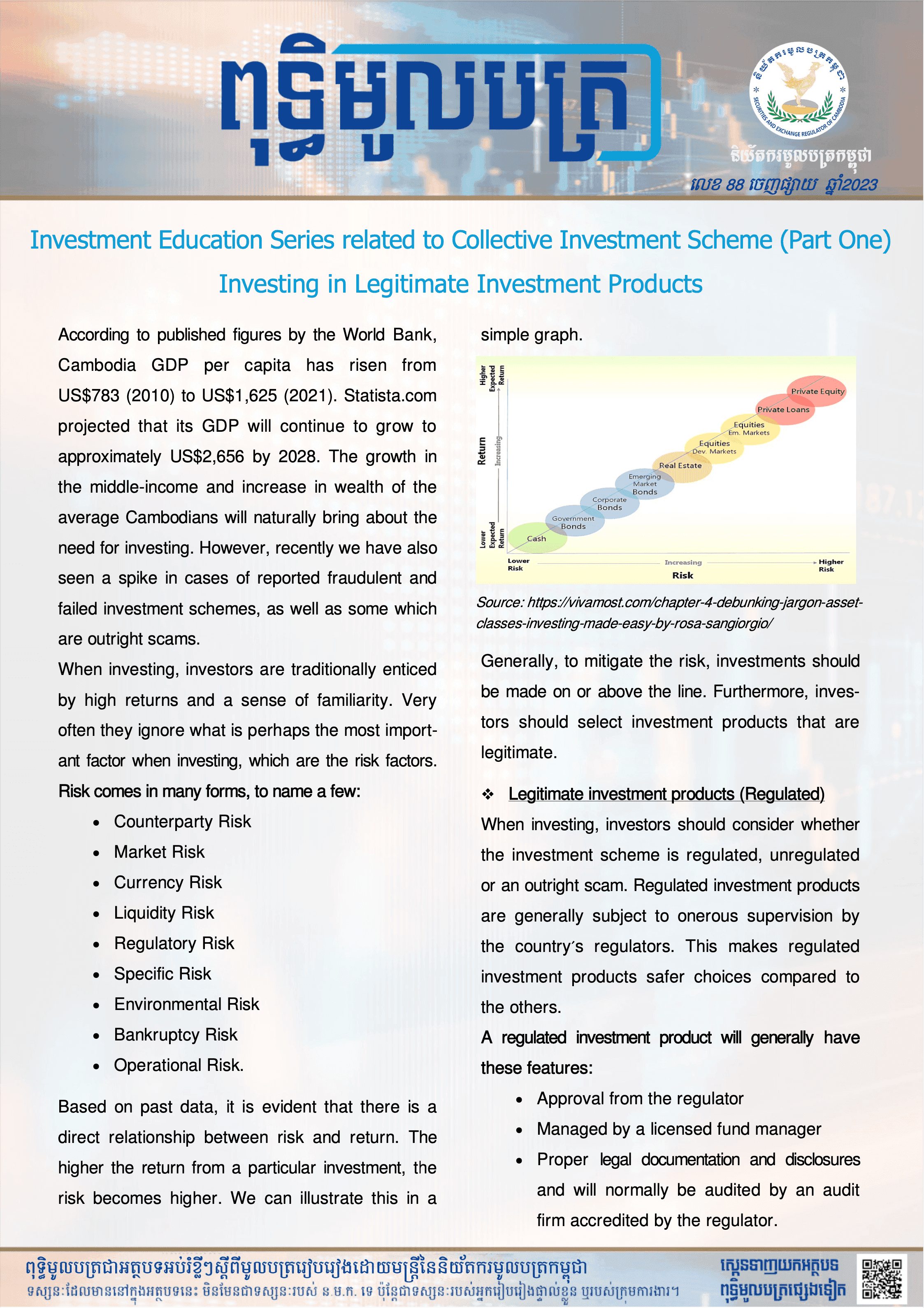
Based on past data, it is evident that there is a direct relationship between risk and return. The higher the return from a particular investment, the risk becomes higher. We can illustrate this in a simple graph.
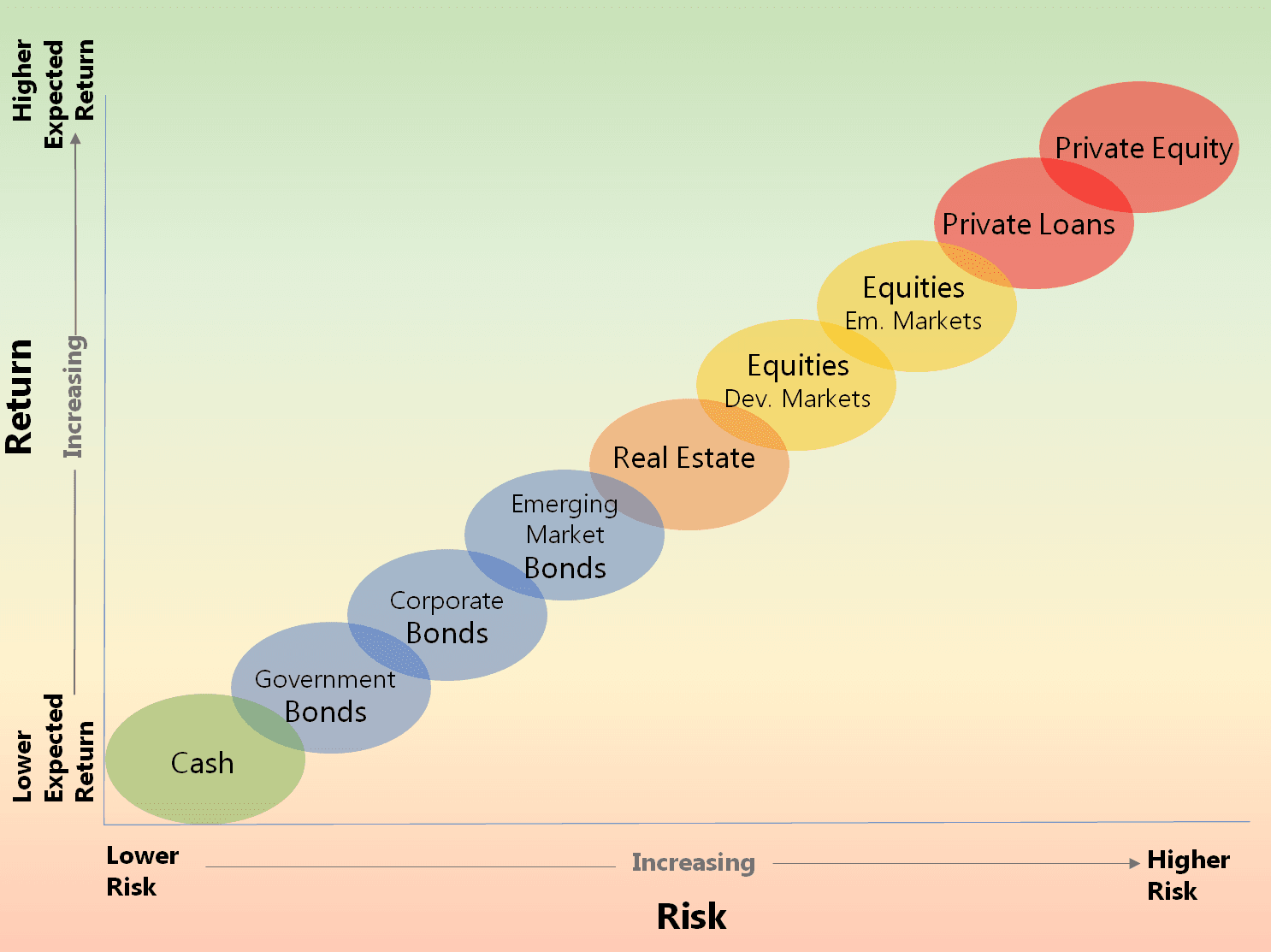
Generally, to mitigate the risk, investments should be made on or above the line. Furthermore, investors should select legitimate investment products.
❖ Legitimate investment products (Regulated)
When investing, investors should consider whether the investment scheme is regulated, unregulated, or an outright scam. Regulated investment products are generally subject to onerous supervision by the country’s regulators. This makes regulated investment products safer choices compared to the others.
A regulated investment product will generally have these features:
- Approval from the regulator
- Managed by a licensed fund manager
- Proper legal documentation and disclosures and will normally be audited by an audit firm accredited by the regulator.
Therefore, the risk of a regulated investment scheme being a fraud is very low.
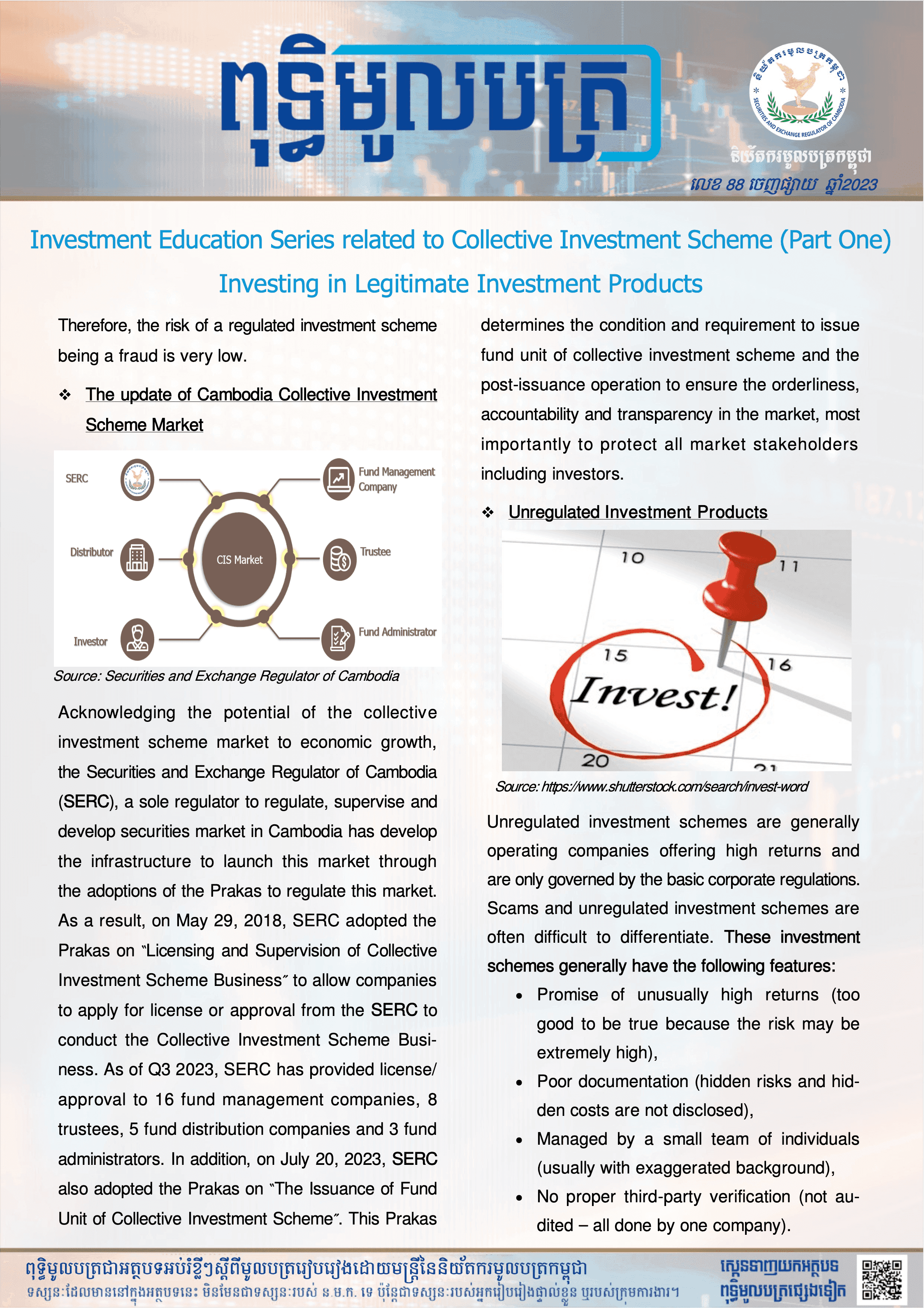
❖ The update of the Cambodia Collective Investment Scheme Market
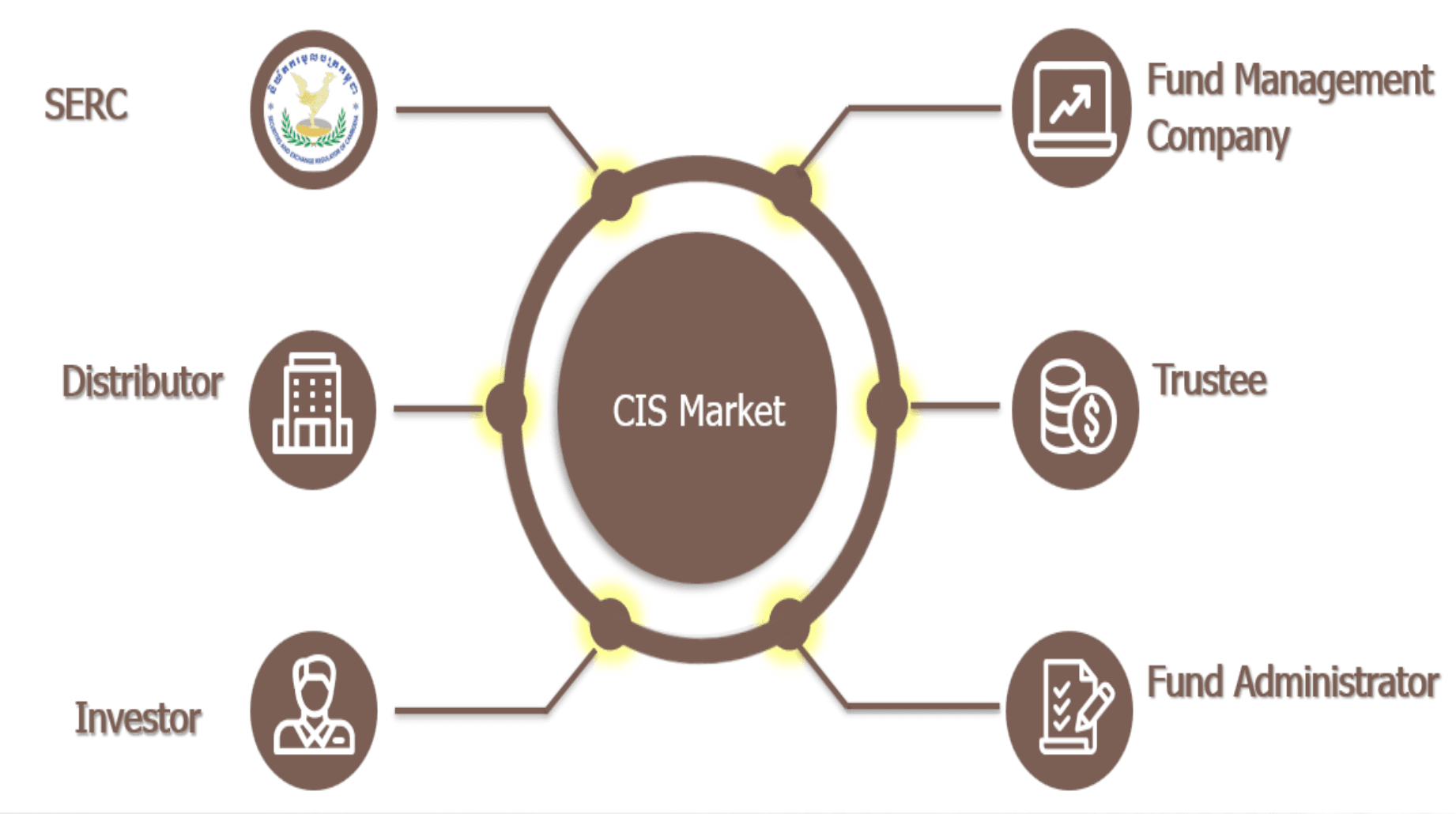
Acknowledging the potential of the collective investment scheme market for economic growth, the Securities and Exchange Regulator of Cambodia (SERC), a sole regulator to regulate, supervise, and develop the securities market in Cambodia has developed the infrastructure to launch this market through the adoption of the Prakas to regulate this market. As a result, on May 29, 2018, SERC adopted the Prakas on “Licensing and Supervision of Collective Investment Scheme Business” to allow companies to apply for a license or approval from the SERC to conduct the Collective Investment Scheme Business. As of Q3 2023, SERC has provided license/approval to 16 fund management companies, 8 trustees, 5 fund distribution companies, and 3 fund administrators. In addition, on July 20, 2023, SERC also adopted the Prakas on “The Issuance of Fund Unit of Collective Investment Scheme”. This Prakas determines the condition and requirement to issue fund units of the collective investment scheme and the post-issuance operation to ensure the orderliness, accountability, and transparency in the market and, most importantly to protect all market stakeholders including investors.
❖ Unregulated Investment Products

Unregulated investment schemes are generally operating companies offering high returns and are only governed by the basic corporate regulations.
Scams and unregulated investment schemes are often difficult to differentiate.
These investment schemes generally have the following features:
- The promise of unusually high returns (too good to be true because the risk may be extremely high),
- Poor documentation (hidden risks and hidden costs are not disclosed),
- Managed by a small team of individuals (usually with exaggerated backgrounds),
- No proper third-party verification (not audited – all done by one company).
- Most importantly, there are no regulators to supervise the legitimacy of the investment schemes.
❖ Scams or Fraudulent Investment Schemes
These are recent cases of unregulated investment schemes that have gone bad in Cambodia:
- The International Forex Trading case of 2019, in which the scheme was operated by a small group of individuals making promises of very high returns. There were no checks and balances and the company was in charge of both making the investment as well as issuing cheques to investors. Such unregulated companies, when unchecked by an independent third party can make false and exaggerated claims.
- In the Empire Big Capital Limited and Investment Consultant Association case of 2017, again this scheme was operated by a small group of individuals making promises of very high returns (10% per month). Similar to the previous case, there were no checks and balances, the company basically did everything internally.
- There were also reports of land investment schemes that have turned sour and were alleged to be fraudulent. Some of these operators have been arrested and charged, and some jailed. The alleged land investment scheme always promised high returns. There is a lack of transparency in how the funds were invested and with regard to the progress of the projects and their cashflows.
It is important to note that there is a difference between an investment scheme going bad and it being an investment scam. All investments have to take risks to generate returns. There are many examples of investments going bad due to poor market conditions and other reasons.
Scams happen when there is no real intent to channel money collected from investors into the stated investment. Instead, profits are fictitiously generated by using money from new investors to pay previous investors. This is known as a Ponzi scheme. Scam operators are in all instances not approved by regulators.
❖ Conclusion
In seeking legitimate investments, investors should consider the following:
- Is the company regulated by the relevant authorities?
- Is the product approved by the relevant authorities?
- Does the investment reasonably justify the return that is promised?
- Does the collective investment scheme have basic checks and balances, like independent lawyers, auditors, and other professionals?
Lastly, trust your instincts. If an investment sounds too good to be true, you should investigate further and ask more questions. In selecting a legitimate investment that fits your risk profile, the investment should diversify your risk and at the same time help you grow your wealth over time.
An article from the Securities & Exchange Regulator of Cambodia (SERC)